
The Cost of Observation: The Hidden Impact of Whale-Watching Tourism
Maia Michelis
Whale tourism is often seen as something completely harmless.
People get on a boat, admire these massive and beautiful animals for a while, take some pictures, and leave. Compared to fishing, pollution, or hunting, it can even feel like one of the more respectful ways humans interact with marine wildlife.
But over the years, science has started to show that these encounters, if not done correctly, may not be as innocent as they seem.
Key Takeaways
Whale-watching tourism can alter whale behavior, even when no obvious distress is visible.
Studies show repeated boat interactions can increase dive times, interrupt rest, and particularly affect mothers with calves.
Vessel noise disrupts whale communication, reducing the distance their calls can travel by more than 60% in some cases.
The biggest risk often comes from repeated exposure, poor regulation enforcement, and too many boats in the same area.
Responsible whale tourism is possible, but it requires strict rules, enforcement, and science-based management.
Whale tourism creates stress for animals
Science has shown that this is taking a toll on whale populations. Choosing more sustainable tourism alternatives may be the better path forward.
Researchers all around the world have dived deep into understanding how whale tourism affects their populations and their physiology in ways that may not always seem obvious to us. Some studies have focused on stress levels, others on how noise disrupts their communication, and many have shown that these interactions can even interfere with feeding, breeding, migration, and breathing patterns.
Before diving into the evidence, let’s remember a few important things about whales. There are three characteristics we should keep in mind when analyzing this data:
Whales are mammals. They have lungs and need to come to the surface to breathe.
They sing and use sound to communicate.
Most species are migratory animals.
So, what have these scientists found that seems so worrying?
Tourist boats affect mother-calf behaviour
A study in Tonga by Fiori et al. (2019) that looked at the behavioural responses of humpback whales to tourism activities found that more than a third of whale-watching boat approaches caused the individuals to avoid the interaction.
Mother whales with calves were especially sensitive. Instead of dramatically swimming away, many responded by staying underwater for longer periods of time, a strategy researchers described as “vertical avoidance.” During swimming tourism activities, mothers nearly tripled the time they spent diving compared to undisturbed conditions. This matters because whales need to breathe, rest, nurse, and recover energy at the surface.
Something similar was observed in the Gulf of Tribugá, Colombia. Girón-Castaño et al. (2025) found that although many whales appeared neutral around boats, mother-calf pairs showed the greatest behavioural changes. Whales reacted more negatively when boats came within 50 meters. Researchers detected changes in dive duration and surface behaviours even when the animals did not visibly flee.
In some cases, mother-calf pairs were resting when boats approached, raising concerns that repeated disturbances could affect calf development and the mother’s energy balance.
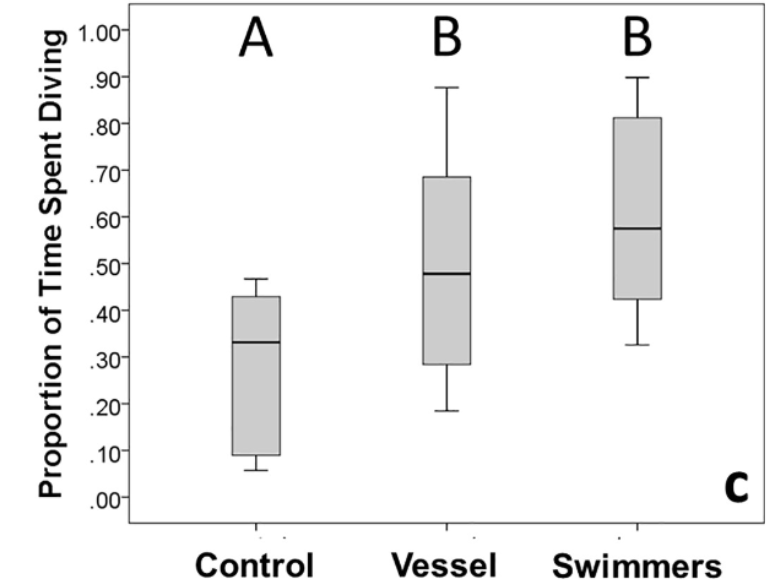
Box plot representation of proportion of time spent diving in absence of tourism activity (control), in presence of swim-with-whale vessel and during the swimming activities (swimmers) for humpback whales mother-calf pairs in Vava’u, Kingdom of Tonga. Graphic: Fiori et al. (2019).
Whale watching disrupts communication
Boats not only change whale behaviour physically. They also change their acoustic world. These animals rely heavily on sound to communicate, navigate, interact across huge distances, and especially to mate. Male whales are known for their incredible “singing voices” and have been proven to use those sounds to attract females.
Sound is such a vital component of a whale’s reality, also due to how easily sound vibrations move through the water, traveling four times faster than vibrations produced in the air. Although we still don't exactly understand what is being shared between individuals, we cannot underestimate the importance that these sounds have in their biology.
Rey-Baquero et al. (2021) on her paper about the effects of vessel noise on humpback whale songs showed that this disruption dramatically reduced the distance over which whale songs could be clearly heard. Just one vessel reduced the whales’ effective communication space by more than 60%.
Researchers also found that whales changed the structure and rhythm of their songs in the presence of engine noise, possibly trying to avoid having their calls masked by boats. Even in a low disturbance area like the Gulf of Tribuga, significant changes in sound behaviour were found, which suggests that no place is immune to vessel noise.
This can inhibit the relevant biological communication related to mating or danger warning, and it can force some individuals to raise the volume of their vocalisations, which comes with an additional energetic cost.
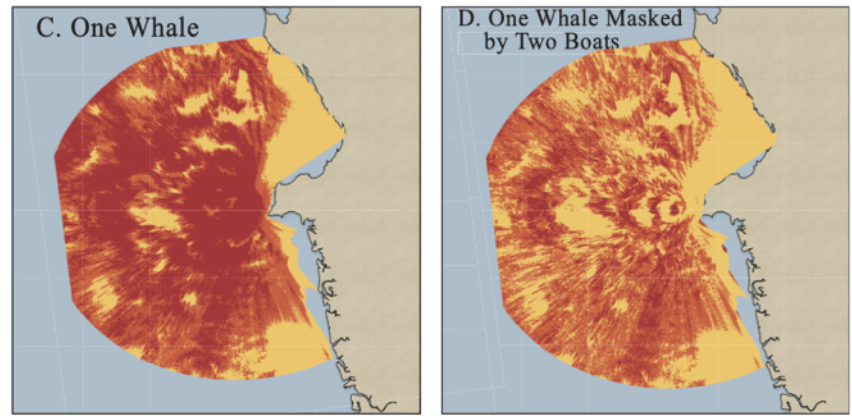
Maps of a high SNR area (a place where the strength of the signal is significantly greater than the background noise or interference) when only ambient noise vs. two boats are present. Red indicates very audible areas of the whale song, orange indicates unreliably audible areas, and yellow indicates masked areas. Figure: Rey-Baquero et al. (2021).
On top of that, it has been demonstrated that the whale watching vessels mask the sounds produced by competitive groups and by mother-calf pairs, which could interfere with social behaviour and parenting care.
The impacts of individual trips add up fast
Together, these studies paint a much bigger picture: whale tourism does not need to involve collisions or obvious panic to have an impact. Sometimes the effects are subtle: longer dives, interrupted rest, and altered communication.
Repeated over time, these small disturbances can reshape how whales use their habitat and interact with each other.
This is one of the key points highlighted across these studies: The negative effects depend heavily on the frequency and accumulation of interactions.
In Vava'u, Tonga, whale-watching operators failed to respect the minimum resting time for whales in 38.4% of encounters, and researchers recorded up to 28 swimming boats interacting with whales at the same time. Because of this, several authors stress the importance of establishing maximum exposure limits in order to prevent long-term population-level consequences.
Correct management of whale tourism
These studies are not arguing against whale tourism itself. In fact, many researchers recognize that responsible whale watching can become a powerful tool for conservation, education, and local economies. The real issue is how these activities are managed.
One of the clearest patterns across the papers is that regulations often exist, but are poorly enforced. In Tonga, for example, the mandatory resting time between whale interactions was ignored in more than a third of encounters.
In Colombia’s Gulf of Tribugá, only a small percentage (13.83%) of vessels actually respected the recommended minimum distance from whales. Researchers warn that guidelines alone are not enough if there is little monitoring, no real enforcement, and no consequences for breaking the rules. In some places, operators eventually realized that infractions rarely led to punishment, which only increased noncompliance over time.
Another major concern is the sheer number of vessels interacting with whales simultaneously, as mentioned in Tonga. Scientists suggest limiting the number of licenses and establishing “exposure caps,” meaning limits to how often and for how long whales can be approached. Even if a single interaction seems harmless, repeated disturbances throughout the day may accumulate into chronic stress and behavioural disruption.
Education also plays a huge role in sustainable tourism. Researchers point out that operators often know the rules, but may not fully understand why they matter biologically. Explaining the ecological reasoning behind distance limits, resting times, and noise reduction can improve compliance far more effectively than vague instructions. Simpler, science-based guidelines are also easier to follow consistently.
And importantly, sustainable whale tourism is not impossible. Places like Puerto Madryn have become internationally recognized examples of more regulated whale watching. It shows that tourism and conservation do not necessarily have to oppose each other, but coexistence requires limits, science-based management, and respect for the animals’ space.
Balancing conservation and tourism
Ultimately, the message repeated across all these studies is that if we truly admire whales, then our presence around them must be designed around their well-being, not just our experience. If you care about these animals, it is greatly encouraged that if you decide to participate in whale tourism, you do so mindfully, researching where you are going, when, and with whom. Making sure all restrictions and guidelines are being followed.
What you can do to be a responsible whale-watching tourist:
Choose certified, ethical operators that follow local wildlife regulations and sustainable tourism guidelines.
Research the company beforehand and make sure they respect minimum approach distances and limits on interaction time. You can search the regulations in your country and see if they respect them.
Avoid tours that overcrowd whales with multiple boats or encourage close, prolonged encounters.
Prioritize operators with smaller groups and quieter vessels, as these reduce disturbance and noise pollution.
Respect wildlife boundaries. If whales move away or change behavior, that’s a sign they need space.
Support destinations with strong conservation policies, where tourism is managed with whale welfare in mind.
Listen to the rules and follow them!
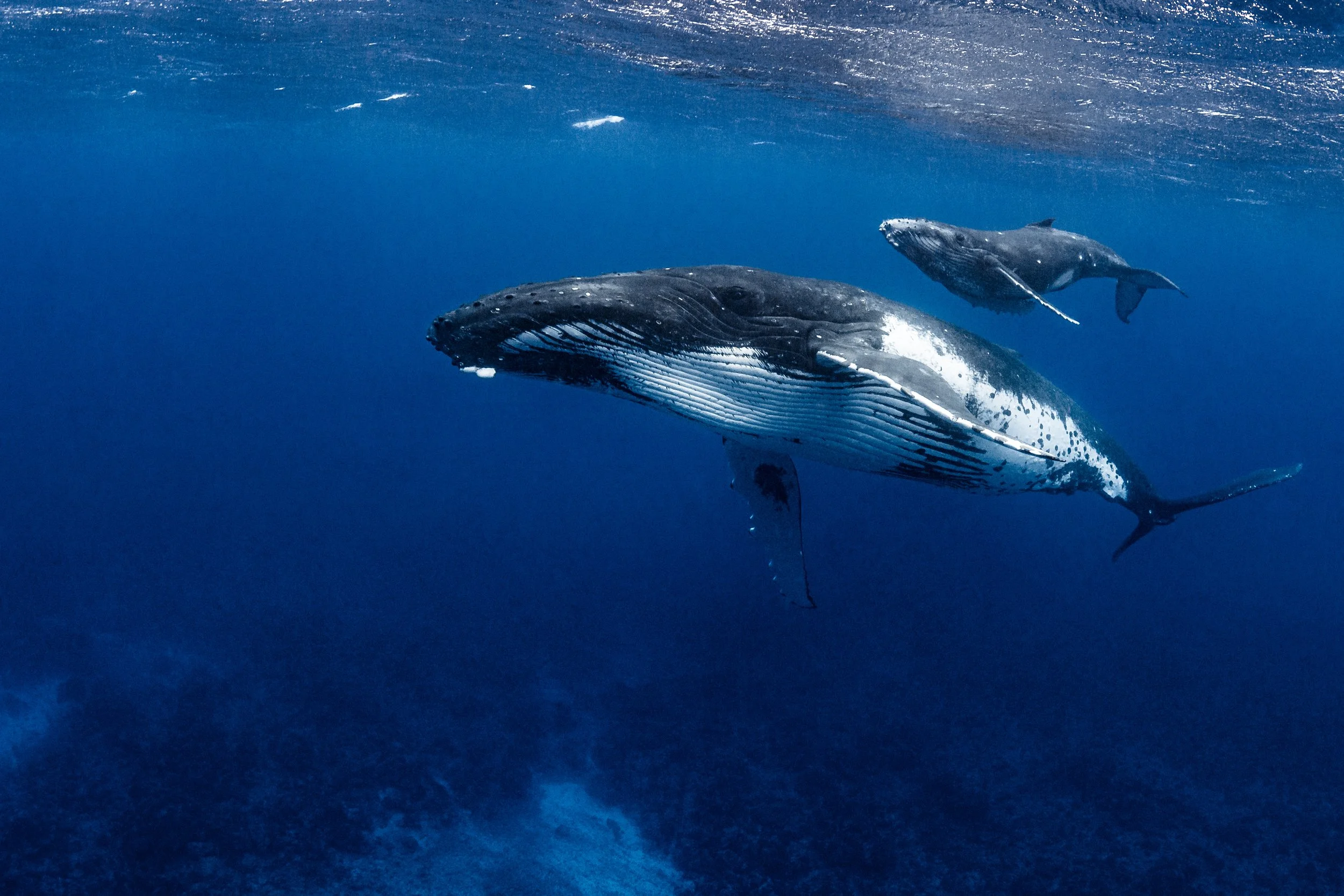
Humpback whale with calf. Photo: Hannes Klostermann / Ocean Image Bank.