
The Long Journey Home: How Human Activities Are Threatening Salmon Migration
Maia Michelis
Each year, millions of salmon and trout embark on one of the most remarkable migrations on Earth.
Born in freshwater rivers and streams, many species travel hundreds or even thousands of kilometers throughout their lives… only to return to the very place where they hatched!
This is a process called homing. Salmon return to their own birthplace to spawn again. They are living proof that the area has a track record for hatching salmon that make it to adulthood. Where better for their offspring to start their own lives?
This extraordinary journey has shaped ecosystems for millions of years. It’s crucial not only for the salmon, but for transporting nutrients between marine and freshwater environments and supporting countless species, from bears and eagles to forests themselves.
Today, however, this ancient migration is increasingly under threat due to human activities.
Understanding how these pressures affect fish is essential not only for conserving the species but also for protecting the ecosystems and communities that rely on them.
Key takeaways
Pacific salmon and trout depend on complex migratory cycles, returning to their natal rivers to reproduce.
Human-made barriers such as culverts, dams, dikes, and floodgates break up (fragment) rivers, preventing access to spawning habitats.
Rising carbon dioxide levels limits the salmon's sense of smell, reducing their ability to navigate and survive migration.
Habitat loss and disrupted migration are contributing to population declines, lower biodiversity, and increased extinction risk.
Restoring river connectivity, removing barriers, and using long-term ecological data are among the most effective conservation strategies available.
Salmon follow a distinctive lifecycle
One of the groups affected are fish belonging to the Pacific Salmon group, in particular species within the genus Oncorhynchus. They are what we call anadromous species, meaning they are born in freshwater, migrate to the ocean to grow, and return to rivers to reproduce.
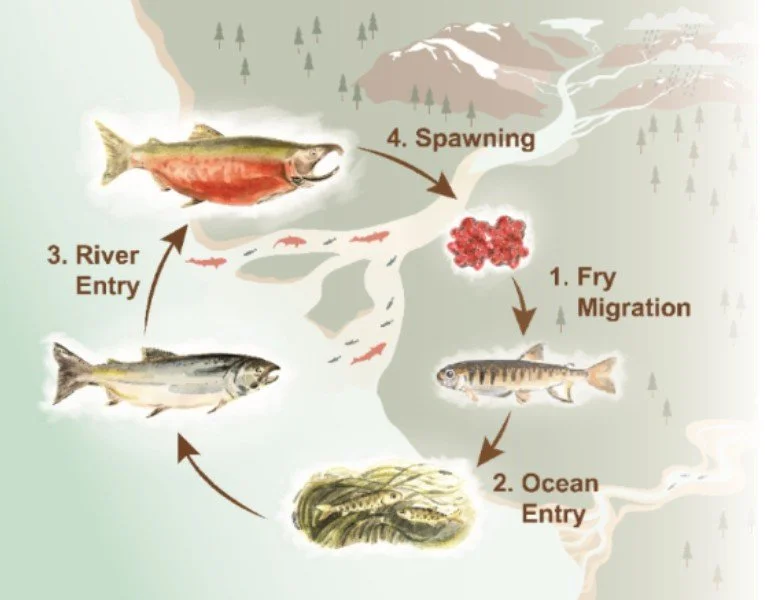
Freshwater life-cycle timing of Pacific salmon and steelhead (Oncorhynchus spp.) in Canada. Image by Wilson, M. S., Peacock, J. S. (2025). Freshwater life-cycle timing of Pacific salmon and steelhead (Oncorhynchus spp.) in Canada. Canadian Journal of Fisheries and Aquatic Sciences, volume 82, pp.1–17.
Their life cycle is complex, spanning several years and thousands of kilometers. Research into this group highlights four key stages that define their physiology and exposure to stressors:
Fry migration: From incubation ponds to freshwater nursery areas.
Entry into the ocean: The moment when juvenile salmon migrate to the sea. The fish must adapt to the different water salinity in a process called smoltification.
Entry into the river: The return of adults to freshwater.
Spawning: The final reproductive stage (only in the case of Pacific salmon; trout can breed more than once).
Migration is influenced by multiple factors
Studies on these fish reveal that migration is not random, but rather influenced by very specific geographic and sensory factors. Human activities are increasingly disrupting these natural mechanisms, making successful migration more difficult.
The timing of migration often correlates with latitude and distance from the ocean. For example, at higher latitudes, the migration of fry and their entry into the sea tend to occur a few days later.
Salmon also rely heavily on their sense of smell to return to their natal rivers, a process known as homing. However, this sensory mechanism is vulnerable to environmental change. Research found that elevated CO₂ levels associated with ocean acidification negatively affect their olfactory system, reducing salmon's ability to detect predators and accurately navigate back to their spawning streams.
Another major threat comes from physical habitat fragmentation. Human-made structures such as dams, culverts, dikes, and floodgates can block migratory routes, isolate populations, and prevent fish from reaching historical spawning grounds. Finn et al. (2021) demonstrated that these barriers significantly restrict migratory behavior. In British Columbia alone, Canada, more than 170,000 closed-bottom culverts impede fish passage, while flood-control infrastructure disconnects large areas of floodplain habitat from salmon populations.
Land-use change and infrastructure development further compound these effects. Expanding road networks alter stream flow, increase sedimentation, and degrade spawning and nursery habitats. In some regions, streams have been entirely converted into drainage channels, eliminating their ecological function and reducing the availability of suitable habitat for migrating salmon.
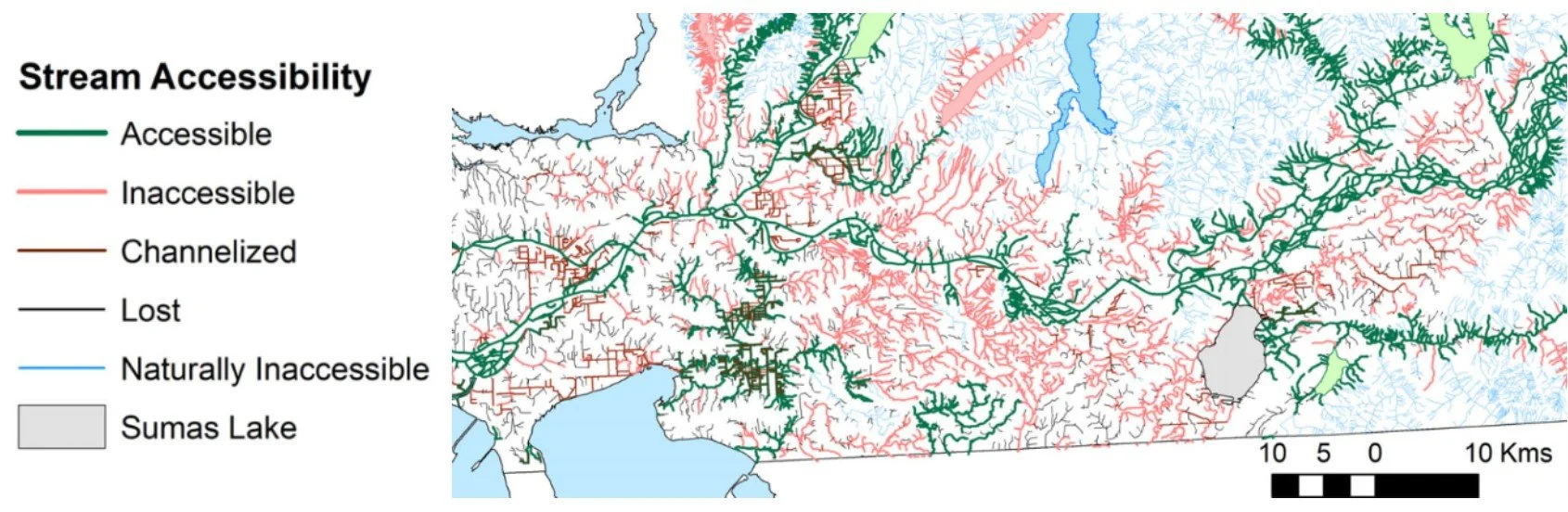
Map of stream connectivity in the Lower Fraser (British Columbia, Canada) according to currently mapped barriers to fish passage. Obtained from: Finn, R. J. R., Chalifour, L., Gergel, S. E., Hinch, S. G., Scott, D. C. & Martin, T. G. (2021). Quantifying lost and inaccessible habitat for Pacific salmon in Canada’s Lower Fraser River. Ecosphere, 12(7), e03646.
Emerging ecological impacts and conservation strategies
Obstructing salmon migration routes clearly leads to a loss of habitat and spawning grounds.
In the Lower Fraser River, man-made barriers have made approximately 2,224 km of stream habitat inaccessible, while another 1,727 km has been completely lost from the landscape. For certain populations, like the Boundary Bay Chinook and coho, up to 70% of their historical stream habitat is now inaccessible. With these come population declines, reaching record lows compared to historical levels, resulting in an increased risk of extinction.
Another consequence is disrupted homing and survival. Because salmon rely on olfactory (smell) cues to find their way home, the impairment caused by CO2 could have a huge effect on their ability to complete their life cycle, potentially leading to higher mortality during migration.
While the situation is critical and management needs to happen fast, the research outlines several strategies being used or recommended to address these issues:
Barrier Removal and Restoration: The removal of barriers is described as "one of the most successful restoration strategies" because of its low cost and high likelihood of success. Specific goals include uncovering buried streams and remediating culverts to restore connectivity to large areas of intact habitat.
Data-Driven Management: Scientists are creating comprehensive databases of salmon life-cycle timing to help managers make evidence-based decisions. This data is crucial for identifying which populations are most at risk and where restoration efforts should be prioritised.
Addressing Knowledge Gaps: A major effort is underway to map "unmapped barriers" (like road-stream intersections) to get a more accurate picture of habitat accessibility. Understanding the historical extent of habitat is seen as vital for setting appropriate restoration targets.
Salmon Under Threat
Salmon migration is one of nature's most extraordinary ecological processes, yet it is increasingly threatened by habitat fragmentation and climate-driven ocean changes.
As migration routes become blocked and environmental conditions continue to shift, the survival of many salmon populations, and the ecosystems that depend on them, is placed at risk. Although the challenges are significant, research shows that restoring river connectivity, removing migration barriers, and supporting conservation with robust scientific data can help safeguard these species and preserve one of the world's most remarkable natural migrations for future generations.