
The World Goes Quiet: What Happens to Your Brain When You Dive?
Maia Michelis
You take the first breath through your regulator and descend. The surface becomes a shimmering patch of light above you. Voices disappear. The world becomes blue, quiet and weightless. Every breath becomes deliberate. Every movement matters. A school of fish passes by, completely indifferent to your presence.
For a few minutes, there is nowhere else to be.
But what is actually happening to our bodies and brains when we enter this unfamiliar world?
Key Takeaways
Scuba diving combines immersion, controlled breathing, reduced everyday sensory input and constant attention, creating conditions that may promote a highly present state.
The human diving response activates a rest response in the body, producing measurable changes in the cardiovascular system.
Early research suggests recreational diving may reduce perceived stress and increase mindfulness, although the evidence remains limited.
The feeling of awe underwater may be just as important as physiological relaxation: the ocean's scale, silence and unfamiliarity can pull our attention completely into the present.
The idea that water is good for the mind now has a name: The Blue Mind. Popularised by marine biologist Wallace J. Nichols in 2014, the concept describes the cognitive and emotional state often associated with being near, in, or on water.
A growing body of research links time around water to lower stress, better mood and improve well-being. And many of those studies take that idea one step further, from being near water to being under it. They ask whether scuba diving, a sport that forces slow, deliberate breathing and full immersion, can measurably calm the nervous system and ease stress and trauma.
Underwater, many of the distractions of everyday life disappear. There are no conversations, notifications, or traffic noises. Your movements are slower. Your breathing becomes conscious. And because your safety depends partly on monitoring your depth, air supply, buoyancy and surroundings, your attention has little choice but to remain in the present. It gives your brain a completely different world to pay attention to.
The findings are promising, but more research is needed.
The mechanism: The diving response
What scientists call “the diving response” is an automated set of reflexes triggered by immersion and facial cooling, best known in marine mammals but present in humans as well. It shifts the body toward "rest and digest" control, largely through the vagus nerve, which slows the heart and dials down sympathetic arousal, which is what prepares your body for physical or mental action during stress or danger.
Ackermann and colleagues published the first analysis of how the diving response affects cardiac vagal activity, measured through heart-rate variability. Pooling 17 studies with 311 participants, they covered triggers ranging from face immersion and facial cooling to SCUBA diving and full-body water immersion. The research found that the diving response reliably switches on the parasympathetic system, calming your mind and body throughout the activity- an incredible find that could be applied by mental health specialists.
This matters for mental health because the same mechanism is already used therapeutically elsewhere. Cold-water face immersion reduces anxiety and panic symptoms, and facial cooling lowers stress responses in healthy people. The diving response, in other words, is a way to activate the calming branch of the nervous system.
But the diving response is only one piece of the puzzle. What makes scuba diving particularly interesting is what happens alongside it.
Being present is key
When you're diving with SCUBA equipment, every few seconds you are processing information: How deep am I? Where is my buddy? How much air do I have? Am I maintaining neutral buoyancy? What is moving over there?
Even experienced divers constantly monitor their environment. At the same time, the physical act of breathing through a regulator makes each breath unusually noticeable.
This creates a strange combination: the body is doing something physiologically complex, while the mind becomes intensely focused on the immediate moment. And that is where diving begins to resemble mindfulness.
Mindfulness is generally described as paying attention to the present moment with awareness, rather than becoming absorbed in thoughts about the past or future. Diving does not automatically make someone mindful, but it creates an environment in which present-moment attention is almost unavoidable.
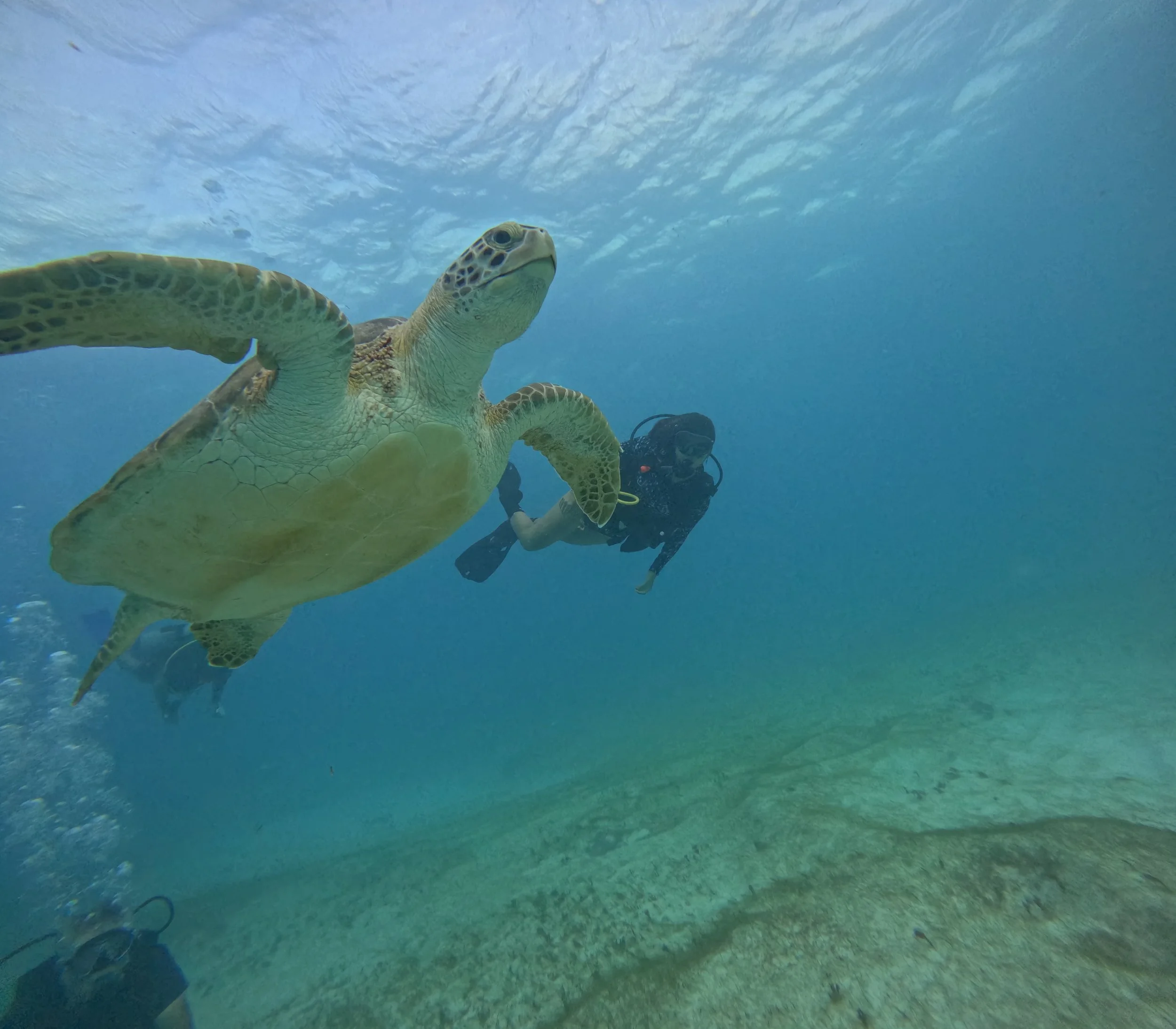
Diver seeing a turtle for the first time. Photo credits: Maia Michelis.
And unlike meditation, there is a reef in front of you. Instead of the familiar sensory landscape of everyday life, you enter a world that is simultaneously alien and real. And then something catches your attention: a turtle gliding past, a ray moving over the sand, sunlight breaking through the surface, thousands of fish turning at once. You stop thinking about what you were doing before the dive, you just watch. This may be where awe enters the picture.
Awe is generally associated with experiences that are vast or difficult to comprehend and that challenge our usual understanding of the world. The ocean is almost designed to produce it. Its scale, complexity and unfamiliarity can make us feel small while simultaneously making us feel connected to something much larger than ourselves. And perhaps that is part of what makes diving feel so different.
It isn't simply that the water is calming. The underwater world is demanding our attention in a way that everyday life rarely does.
Diving as stress management
The first clinical test that tried to bring results about diving lowering stress levels came from the hands of a laboratory of scientists in France. They ran an exploratory trial comparing a one-week recreational scuba course (37 divers) against a one-week multisport course (30 controls), measuring perceived stress, mood, well-being, and mindfulness before and after. The results favored diving.
More concretely, 13.5% of divers fell below the clinical stress threshold after the week, versus 6.7% of the multisport group. And the stress reduction translated into well-being gains only for the divers. Both courses improved mood, so part of the benefit is simply moving your body and a good holiday rest, but the stress-specific effect belonged only to diving.
Why would diving beat other sports? The authors point to its resemblance to meditation.
Diving demands slow, deep, steady breathing, the kind known to increase heart-rate variability and rebalance the autonomic nervous system. Combined with the immersive sensory input of being underwater, recreational diving can function as a form of mindfulness practice.
So, why does SCUBA diving feel so good for the mind?
The diving response is a real, measurable physiological event that boosts parasympathetic, vagal activity. That calming signal appears to translate into lower perceived stress in healthy adults, and into at least short-term relief of trauma symptoms in people with PTSD.
The thread that ties it together is mindfulness: diving forces slow breathing and present-moment attention, the same ingredients as meditation.
The evidence is still thin. Sample sizes are small, most studies are pilots or reviews, and authors repeatedly call for better-controlled research.
But “the blue mind” idea has moved from anecdote to experiment. These studies suggest that scuba diving is not just a pleasant way to spend time in water, it is also a physiologically grounded intervention that activates the calming branch of the nervous system and, in early trials, reduces stress and trauma symptoms.
The work is preliminary, but the direction is consistent: water, and diving in particular, may be one of the more enjoyable ways to switch the nervous system into a restorative state.
When you descend beneath the surface, you leave behind the sensory and mental landscape of everyday life and enter another one entirely. For a while, your attention narrows to a breath, a movement, a fish passing by.
Maybe the magic of diving isn't that it makes us forget the world. Maybe it is that it forces us to experience the world differently.
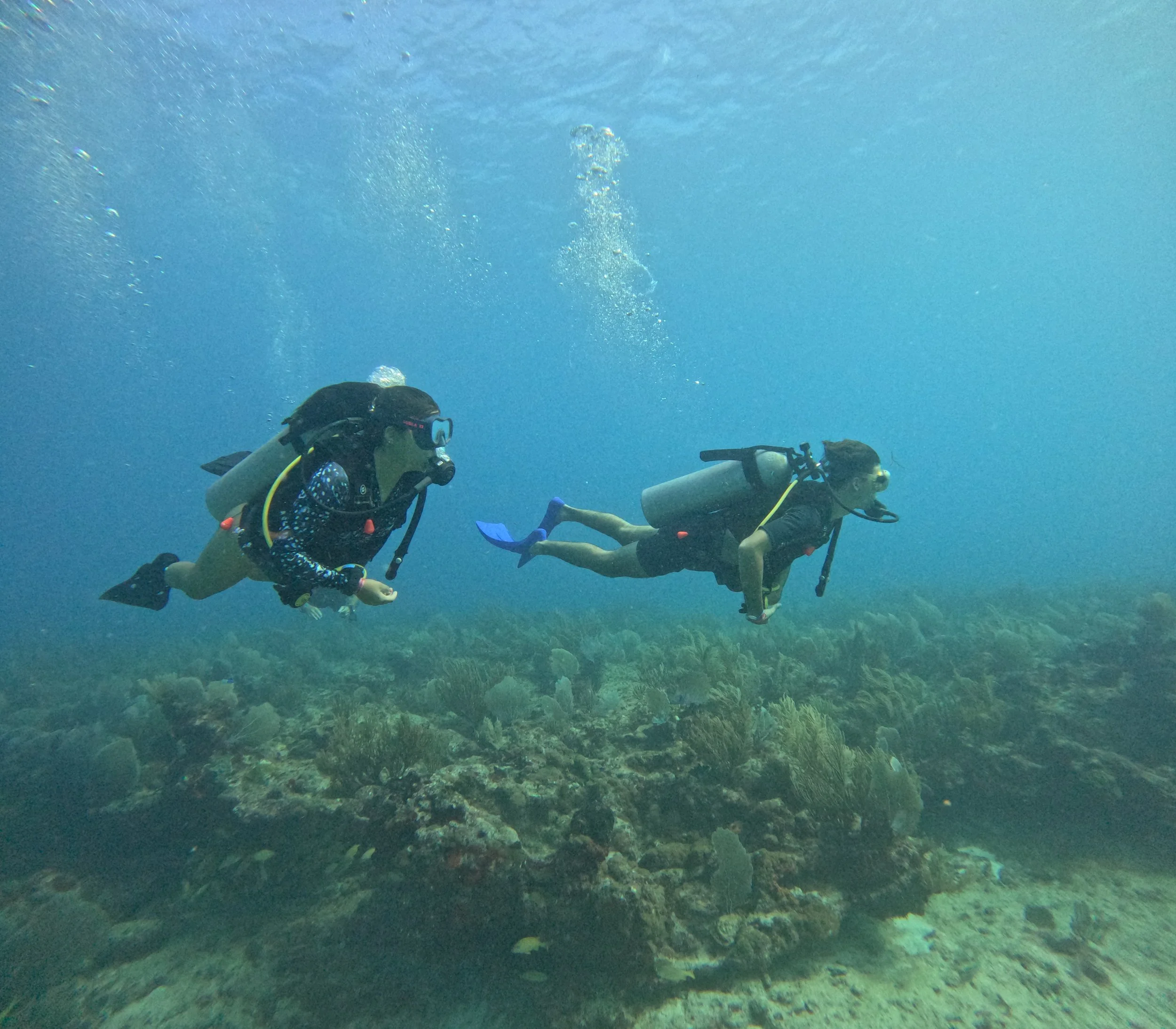
Two divers enjoying a reef. Photo credits: Maia Michelis.
References:
Nichols, W. J. (2024). The Blue Mind Movement. Wallace J. Nichols. https://www.wallacejnichols.org/122/blue-mind.html
Ackermann, S. P., Raab, M., Backschat, S., Smith, D. J. C., Javelle, F., & Laborde, S. (2022). The diving response and cardiac vagal activity: A systematic review and meta-analysis. Psychophysiology, Volume 60, Issue 3. https://doi.org/10.1111/psyp.14183
Beneton, F., Michoud, G., Coulange, M., Lainé, N., Ramdani, C., Borgnetta, M., Breton, P., Guieu, R., Rostain, J. C., & Trousselard, M. (2017). Recreational diving practice for stress management: An exploratory trial. Frontiers in Psychology, Volume 8. https://doi.org/10.3389/fpsyg.2017.02193
Gibert, L., Coulange, M., Reynier, J.-C., Le Quiniat, F., Molle, A., Bénéton, F., Meurice, V., Micoulaud, J.-A., & Trousselard, M. (2022). Comparing meditative scuba diving versus multisport activities to improve post-traumatic stress disorder symptoms: A pilot, randomized controlled clinical trial. European Journal of Psychotraumatology, Volume 13. https://doi.org/10.1080/20008198.2022.2031590
Mindful Staff. (2025, May 15). What is mindfulness? Mindful. https://www.mindful.org/what-is-mindfulness/
If you’ve enjoyed this article from Maia Michelis, follow her on Instagram and LinkedIn.
Want to write for us? Check out our ‘Get Involved’ section